Published by:

Dalibor Vuchikj
11 Aug 2022
My vision is to support companies and organizations in the development and implementation of mechanical engineering and operational projects. As a Mechanical Engineer by education, combined with a deep passion for new technologies. Specialize in offering cutting-edge digital methods and technologies, including 3D scanning, intelligent 3D modeling, documentation, 3D data processing and optimization, analysis, simulations, VR integration, and more.

Improving Factory Layouts with Extended Reality (XR, VR and AR)
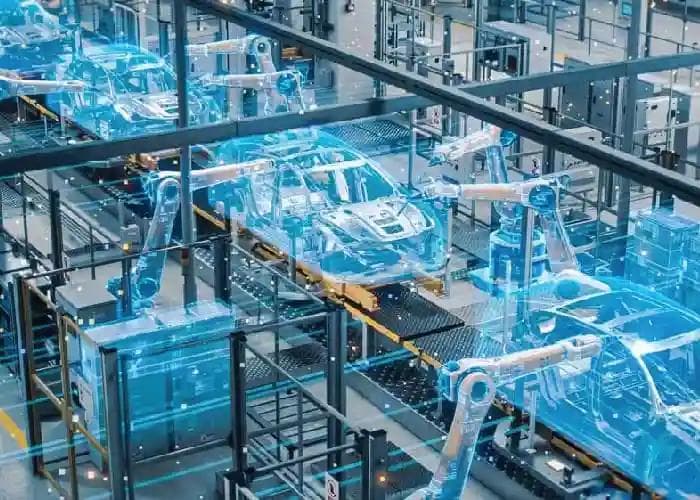
Extended Reality (XR) allows engineering teams to review factory layouts at full scale before changes are made on site. Using Virtual Reality (VR) and Augmented Reality (AR), teams can explore production areas, equipment positions, access routes, working spaces, and other important parts of a factory layout in an interactive 3D environment.
Full-Scale Factory Layout Reviews
Factory layouts can contain production equipment, robot cells, storage areas, mechanical installations, access routes, and many other components. Reviewing all these elements on a traditional 2D drawing or computer screen can make it difficult to understand their real size and spatial relationships.
XR allows engineers to view the factory layout at full scale and from different positions. This can help identify equipment clashes, limited access, missing elements, insufficient working space, and other layout issues before physical changes are made.
Using Existing CAD and 3D Data
Factory layouts often combine information from different sources. Equipment may be created in mechanical CAD software, production lines may come from specialized engineering systems, while existing buildings and installations can be captured through 3D laser scanning.
This data can be combined and prepared for use in an XR environment. Existing CAD models, BIM models, point clouds, and as-built 3D models can provide the base for reviewing both current conditions and proposed changes.
This approach allows teams to work with available engineering data instead of creating the complete factory environment again from the beginning.
Equipment Positioning and Layout Planning
3D equipment and machinery can be positioned within a digital factory environment to study different layout options. Engineers can review distances, equipment orientation, access routes, available working areas, and relationships between machines and surrounding structures.
Different layout options can be tested before equipment is moved, installed, or ordered. This gives project teams a practical way to compare solutions and discuss proposed changes before implementation.
Ergonomics and Worker Access
Factory layout reviews should also consider the people who operate and maintain the equipment. Human-scale representations can be used to study reach, visibility, working positions, access, and available space around machines.
These reviews can help teams identify areas where operators or maintenance personnel may have limited access or where a proposed equipment position could create unnecessary difficulties during normal operation.
Testing Different Factory Layout Options
XR environments can be used to perform “what-if” studies before changes are made to the real factory. Equipment positions, production areas, access routes, and other layout elements can be changed and reviewed in a virtual environment.
This is particularly useful when planning new production lines, equipment upgrades, factory expansions, or changes to existing manufacturing processes.
Testing different options digitally can help teams identify potential problems earlier and reduce unnecessary modifications during installation.
Design Reviews and Team Collaboration
Factory layout projects often involve engineers, operators, managers, equipment suppliers, contractors, and other stakeholders. XR provides a shared 3D environment where different participants can review the same layout and discuss proposed changes.
Remote teams can also participate in design reviews without always needing to travel to the factory. This can improve communication between teams working from different offices, countries, or project locations.
Planning for Installation and Maintenance
A factory layout should support not only production but also equipment installation, operation, inspection, repair, and maintenance.
Full-scale 3D reviews can help engineering teams check whether sufficient space is available around machines, whether components can be removed for maintenance, and whether workers can safely access important equipment.
When the proposed layout is reviewed before implementation, potential access and maintenance problems can be addressed during the planning stage rather than after equipment has been installed.
From Existing Factory to Proposed Layout
3D laser scanning can capture the current condition of an existing factory and provide accurate point cloud data. From this data, as-built 3D models can be created and combined with new equipment or proposed layout changes.
This creates a digital representation where engineering teams can compare existing conditions with future plans and review how new equipment will fit within the available space.
At IN3D Technology, we combine 3D laser scanning, CAD and BIM modeling, as-built data, and XR technologies to support factory layout planning and design reviews. Our goal is to help engineering teams understand existing conditions, review proposed changes, identify potential issues, and make better-informed decisions before work begins on site.